
Entrance to The Surreal House
Today, a visit to The Surreal House exhibition at the Barbican. It was recommend to me quite a while ago to pay a visit here, but having only just managed to get around to it, am glad I took the time. Anyone familiar with the gallery space at the Barbican will know it is often a ‘difficult’ space to fill, with a larger open space on the lower level, and a series of smaller rooms, or rather large alcoves, on the upper level, from where it is also possible to view the lower level, and vice versa. This sense of different levels and viewpoints seemed to work well, however, certainly giving any visitor the sense of having entered a kind of ‘house’ space, and offering the opportunity to view exhibits and films from differing angles. The aim of the exhibition was to showcase the links between the concept of the house and surrealism, and while many of the exhibits were certainly familiar, it was intriguing to have the opportunity to look at them again from a different viewpoint. Interestingly, there was a mix of exhibits by the ‘original’ surrealist artists, writers and designers, such as André Breton, Dora Maar, Alberto Giacometti, Salvador Dalí and Marcel Duchamp, complemented by others whose work has shown a surrealistic influence, or whose work includes elements of the surreal, such as Louise Bourgeois, Berlinde de Bruyckere, Francis Bacon, Francesca Woodman, Jan Švankmajer, Joseph Cornell, Paul Thek and Gordon Matta-Clark.

Untitled (Black Bath), Rachel Whiteread, 1996
In keeping with the ideas around the surreal, it was curious to see a number of exhibits appearing seemingly out of context, or in curious juxtaposition. Most striking perhaps was Lucien Freud’s leather desk chair, on loan from the Freud Museum in London, which was displayed alone behind a glass panel, appearing almost like a spectre, the chair of an interrogator or a torturer. Rachel Whiteread’s Untitled (Black Bath), 1996, meanwhile, certainly had the ‘’demeanour of a stately sarcophagus’’, as the exhibition blurb put it. Interested in dreams and the possibilities of dreams, the surrealists were much influenced by the use of film, and also made much use of the medium, and visitors could certainly spend much time in this exhibition exploring the various manifestations of this. I was particularly intrigued by a series of photographs by Francesca Woodman, and the theme of appearances and disappearances that was evident. Jan Svenkmajer’s films Jabbawocky and Down the Cellar, were also still startling instances of mixing the surreal with a playful, yet very dark and grown-up sense of intrigue and possible danger. In particular, Down the Cellar conveyed a sense of how we ourselves often mix these up in everyday life, making us question what is ‘real’ or ‘unreal’.
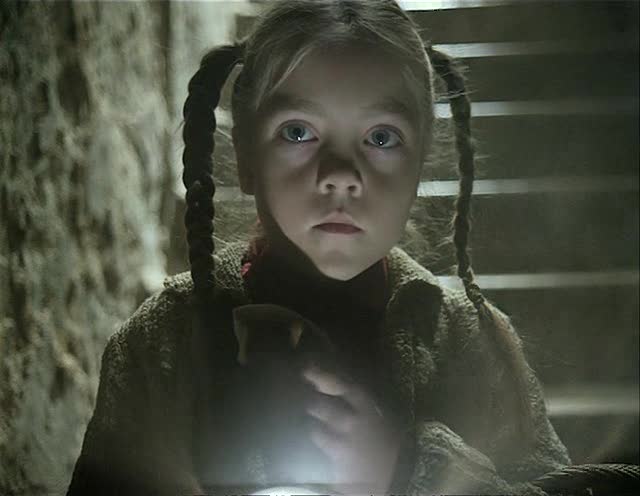
Still from Down the Cellar, Dir. Jan Švankmajer, 1982
As someone interested in fashion as a research pursuit this exhibition was again a reminder of how the collaboration between art and fashion has perhaps been most successful in their meeting through surrealism, or surrealistic elements. Fashion is often perceived to be ‘ridiculous’ or ‘absurd’, as so many media commentators on the fashion still take great delight in emphasising during the bi-annual catwalk presentations. Yet it is this very absurdity that continues to make fashion relevant as source of release from the mundanity of everyday life, which all of us need from time-to-time. The only outfits, as such, included in the exhibition were a pair of latex dresses from 1979 by Louise Bourgeois. Other ‘fashion artefacts’, if they may be called that included Alberto Giacometti’s Table Surrealiste of 1933/1969, a kind of ‘’dressing table’’, with four different legs, a veiled mannequins head and a dismembered hand. The walls of the exhibition itself were also painted grey, almost like a ‘’traditional’’ haute couture salon, or some rooms appeared in shades of pink or a deep plum/aubergine colour, and indeed the overall ambience of the exhibition could be described as ‘’chic’’, with a sense of the exhibits being both well lit and well placed. I especially liked the placing of the antique glass vitrines in several of the rooms, adding a sense of both the ‘’traditional’’ practices of curatorial display and also a play on the idea of the ‘’wunderkamer’’ or ‘’wonder room’’, or looking at ‘’an exhibition-inside-an-exhibition’’. Perhaps the most ‘’fashionable’’ exhibits, however, were a series of black–and-white prints made by Nicholas de Larmessin (1640-1725) illustrating a number of trades-people, including a lingerie seller and a miller. Their appeal as surrealistic inspiration was evident in the very bodies or outfits of the figures in the prints as they were made up of the accoutrements of their trade, even including their headwear and footwear. It is very possible to imagine how these extraordinary outfits may be realised in ‘’real-life’’ on the catwalk at Christian Dior.

Table Surrealiste, Alberto Giacometti, 1933 (1969)

Installation view of Table Surrealiste
Although not a ‘’fashion exhibition’’ per se, The Surreal House was an interesting example of how fashion permeates different areas, and also how the realm of the domestic, that is ‘’the house’’, continues to have such a profound influence. In developing my own work as a researcher through the medium of film it was also a good opportunity to view a number of films, not only to view the film-making of the films themselves, but also to engage with how film is presented. The Surreal House showed its selection of films on both large and small screens, sometimes with the opportunity to sit on a bench if the film was of a longer length. Interestingly, the section Electric Cinema, featured a miniature version of a real cinema, with plush red curtains on the walls and matching, ‘’real’’, old-style cinema seats, offering the visitor a ‘’real-life’’ cinema experience, with a series of full-length feature films, such as the surreal masterpiece La Belle et La Bête. In the creation of films, this is perhaps an aspect that is often not fully realised, yet with the growth of 3-D presentations as way of enticing and retaining people’s interest in the cinematic experience, this is an area that retains a great many possibilities to explore and consider. Echoing the surrealism and filmic quality of the day, I arrived at the exhibition on an overcast, if dry day, and left in the rain, weaving my way to the tube station without an umbrella through the labyrinth that is the Barbican complex...
Resources:
Barbican: http://www.barbican.org.uk/


